Monday, August 19, 2013

The Mystical Meaning of Shofar

The Mystical Meaning of Shofar 

Arthur L. Finkle

Several articles address the religious, social, political, cultural and philosophical meaning of Shofar. No articles currently in circulation address the mystical tradition of Shofar. Jewish mysticism is rich in tradition, citing Shimon Bar Yochai as a founder. In 1176, the Bahir was published by the Provence (Southern France) School of Kabbalists). However, it is ascribed to R. Nechuniah ben HaKana, a disciple of bar Yochai. It is mentioned by the Ravaad, the Ramban and the Zohar. Then xx’ Moses De Leon in the 13th century claims to have found the Zohar, a masterly mystical treatise. Then mystics flourished in Spain during its Jewish Golden Age (Ramban, Abulafia, R. Moshe Cordevero, etc.). Primary Jewish Mystical Texts Sefer Yetzirah ("book of creation") was the first historically recorded book on Kabbalah. Meaningless to those not schooled in mysticism, student could understand it only with a competent mentor. The second of the important Jewish mystical works is the Bahir ("the illumination"), also known as "The Midrash of Rabbi Nechuniah ben haKana". It is some 12,000 words long. First published in Provence in 1176, many Orthodox Jews believe that the author was Rabbi Nehuniah ben haKana, a Talmudic sage of the first century. Historians have shown that the book was likely written not long before it was published. The Zohar (זהר "the radiance") is arguably the most important book written on Jewish mysticism. Attributed to Rabbi Shimon ben Yochai, a 2nd century Talmudic commentator, it is generally assigned to a 13th century Spanish Jew, Moshe de Leon. There are those (mostly non-religious) who doubt that the Zohar was written by Rabbi Shimon bar Yochai. Moshe de Leon was in possession of the manuscript and claimed it was Rabbi Shimon bar Yochai’s work. Other sages authenticated this (possibly Abulafia, or Rabbi Levi ben Gershon aka Ralbag). The Zohar contains and elaborates upon much of the material found in Sefer Yetzirah and Sefer Bahir, and without question is the Kabbalistic work par excellance. Kabbalistic Teachings about the Human Soul The Zohar posits that the human soul has three elements, the nefesh, ru'ah, and neshamah. The nefesh is found in all humans, and enters the physical body at birth. It is the source of one's physical and psychological nature. The next two parts of the soul are not implanted at birth, but are slowly created over time; their development depends on the actions and beliefs of the individual. They are said to only fully exist in people awakened spiritually. A common way of explaining the five parts of the soul is as follows: • Nefesh (נפש) - the lower part, or animal part, of the soul. Is linked to instincts and bodily cravings. • Ruach (רוח) - the middle soul, the spirit. It contains the moral virtues and the ability to distinguish between good and evil. • Neshamah (נשמה) - the higher soul, or super-soul. This separates man from all other lifeforms. It is related to the intellect, and allows man to enjoy and benefit from the afterlife. This part of the soul is provided both to Jew and non-Jew alike at birth. It allows one to have some awareness of the existence and presence of God. • Ha’tah – Higher spiritual plane • Yichuda – unite with HaKOM In addition, there are five “realms” through which the “soul” travels. From lowest to highest: • Asiyah (World of Activity, Making or Physical Manifestation). • Yetzirah (World of Formation), and • B'riyah (World of Creation), • Atziluth (World of Emanation), • Atziluth is also called the "Supernal World." • It is rooted in the Sefirah Crown/Above and correlates with the letter Yod in the Name YHVH. In Atziluth, the twenty-two Hebrew letters are yet unmanifest, In the sixteenth century, R. Isaac Luria (Arizal) (1534-72) and his fellow mystics of Safed concerned themselves Messianic Redemption consequent to the Spanish expulsion (and its mass conversions). He overturned the Talmudic restriction that before studying mysticism one had to attain the age of thirty-nine, leading to the spread of Jewish mysticism. His fast-traveling doctrines included Tzimtzum (contraction); the breaking of the vessels: and Tikkun: (restoration and repair). Simply put, Luria ingeniously fashioned a metaphor of God’s contracting the universe to create the world, among other things. The shofar is metaphor in Lurianic mysticism. The Shofar service begins with Ps. 47, which recites God’s name seven times. And the the Psalm, itself, is repeated seven times in traditional settings. Seven is mystical number often used is Lurianic mysticism. The psalm is followed by seven verses, six if which form an acrostic, ("destroy Satan"), also a Lurianic theme. Rabbi Isaac Luria Rabbi Isaac Luria (1534-1572) revolutionized the study of Jewish mysticism through Kabbalah. He married, had an family and, for seven years, meditated on the Zohar. Luria believed that deceased teachers of the past spoke to him and that he had frequent interviews with Elijah the prophet. He made mysticism available to those who were inclined the meaning of existence and one’s [lace in it.. See Shira Schoenberg , Rabbi Isaac Ben Solomon Luria, http://www.jewishvirtuallibrary.org/jsource/biography/Luria.html The Lurianic Kabbalah is an extremely complex system of thought . Like Maimonides, it speaks between the lines (occult and hidden).See M. Idel, Messianic Mystics (New Haven: Yale University Press, 1999), p. 170 Number “7” Ancient Egyptian civilization interpreded the number “7” a representation of God. Number seven appears in the Tanach. To cites a few examples: Seven Days of Creation (Genesis 1) Anyone who dares to kill Cain 'will suffer vengeance seven times over (Genesis 4:15) Lamech in his "Song of the Sword" claims that 'if Cain shall be avenged sevenfold', he himself shall be 'seventy-sevenfold' (Genesis 4:24) Seven years of plenty and seven years of famine in Pharaoh's dream (Genesis 41) In regards to the sin sacrifice, the anointed priest was to sprinkle the bullock's blood seven times before the lord (Leviticus 4:6) Seven days of the feast of Passover (Exodus 13:3–10) Creation of the seven day week and the pattern concerning distribution and use of manna (Exodus 16) The Menorah crafts as a seven-branched candelabrum, occupying a hold p[lace in the Temple. (Exodus 25) Seven year cycle around the years of Jubilee (Leviticus 25) Jericho's walls fall on the seventh day after seven priests with seven trumpets march around the city seven times (Joshua 6:8) Seven things that are detestable to the LORD (Proverbs 6:16–19) Seven Pillars of the House of Wisdom (Proverbs 9:1) Arthur I. Miller posits that there are seven planets and that Moses heard seven voices on Mou4int Sinai (as he received the Ten Commandments). Deciphering the Cosmic Number: See Arthur I. Miller, The Strange Friendship of Wolfgang Pauli, . WW Norton Maimonides provides “seven causes that should account for the contradictory and contrary statements to be found in any book or compilation.” Regarding the last of the seven, he writes: The seventh cause. In speaking about very obscure matters, it is necessary to conceal some parts and disclose others. Sometimes in the case of certain dicta this necessity requires that the discussion proceed on the basis of a certain premise, whereas in another. M. D. Chenu, Nature, Man and Society in the Twelfth Century, p. 103; Quintilian, Institutes of Oratory, trans. H. E. Butler London, 1953), vol. 8, sec. 23. Tradition holds that God created seven before the world (Pes 54): Torah, resentence, paradise, gehinnah, throne of glory, name of God and name of messiah. In Lurianic Mysticism, the lower seven sefirot (Wisdom and Understanding) begat an offspring :Tiferet . Tiferet connotes mercy or non-rational action. In other words, the shofar not only oeeierces the façade of knowledge and understanding of the human, but it also resonates with the emotional or religious soul. See Lawrence Fine, Safed Spirituality: Rules of Mystical Language As The Vehicle Of Creation The idea that language as the vehicle of creation is present in the earliest Kabbalistic text, Sefer ha-Bahir. It proclaims the world was created through divine speech in the Primordial Ether (Avir Kadmon). Could this be the shofar? www.newkabbalah.com ©Sanford L. Drob, 2003. Sound of the Shofar The Rebbe, (Rabbi M. M. Schneerson, (t’l) posited that the sound of the shofar represents a burst of emotion beyond words There are things that are important that shake us to the core. The very core of our souls crying, "Father! Father!" http://www.chabad.org/holidays/JewishNewYear/template_cdo/aid/315559/jewish/Shofar.htm Renewal Reb Levi Yitzchak of Berdichev taught that the central observance of Rosh Hashanah is the blowing of the shofar. The sound of the shofar, heard on the first day of Tishrei, represented the re-cycling of a new year. In Hassidic terns, a this recycling is a continuation of the act of creation that the world needs this cosmic energy in order to continue. God’s Voice The Lubavitcher Rebbe, Rabbi Menachem M. Schneerson (z’l) made another analogy that the High holy Days are based on coronation, repentance and Shofar. Coronation refers to the Kingship that humankind establishes with God, both reaching up and its reaching down to embrace humankind. Repentance (tshuvah) is a major part of the High Holy Days. Indeed, during these ten days, Jews are obligated to atone for their sins and to purify their souls. There is also an obligation (mitzvah) for sounding the Shofar. The mitzvah of the day is the sounding of the shofar."( Rosh HaShanah 27a.)] That is to say, not only does Rosh HaShanah contain characteristics that are exclusive to the theme and conception of Rosh HaShanah alone, and not only does Rosh HaShanah include shared features common to all the Ten Days of Repentance, but it also possesses its own "mitzvah of the day" - sounding the shofar. http://www.sichosinenglish.org/books/chassidic-dimension-festivals-1/03.htm. ACCESSED July 5, 2009. Basically, he equates the sound of the Shofar with God’s voice, on a mystical level! Such a voice is awesome is bespeaks the solemnity and grandiosity of the High Holidays in the lives of the Jewish People. He then resolves the lulav and etrog paradox on the Sabbath by indicating that Sukkot does not require the Godliness of “delight,” which is only reserved for the Sabbath, Rosh Hashanah, Yom Kippur and the announcement of the Messiah! Moreover, the voice of God is mentioned in the Bible as God’s voice and as God’s voice cessation [In Sedra Yitro, Gen. 18:1-18], The sound of the shofar grew increasingly stronger; Moses would speak and God would answer him with a voice. יט. וַיְהִי קוֹל הַשּׁוֹפָר הוֹלֵךְ וְחָזֵק מְאֹד מֹשֶׁה יְדַבֵּר וְהָאֱ־לֹהִים יַעֲנֶנּוּ בְקוֹל: grew increasingly stronger:
Rabbi Larry Freedman http://www.templesinaipgh.org/Door-columns/sermons/HH2005/RH1-LF.pdf

Monday, August 05, 2013

Sounding Shofar During Morning Services During Elul


Sounding Shofar During Morning Services During Elul

Arthur L. Finkle

The Code of Jewish Law (Shulhan Arukh, I28:8) instructs that the shofar be sounded in the period between rosh hodesh (new month) Elul until after Yom Kippur. The religious rationale was that Moses ascended Mount Sinai to receive the second tablets; dwelt there for 40 days; and descended on the tenth of Tishre, when the Israelites completed atonement for creating the Golden Calf. The musi­cal rationale is that a forty-day period provided the necessary practice for the Shofar Sounder to develop the appropriate embouchure.

The religious rationale come from the Midrash (Pirkei d'R' Eliezer 45; R. Eliezer ben Hyrcanus (80-118 C.E.), a disciple of Rabbi Yochanan ben Zakai and teacher of Rabbi Akiva):
[During the Jews' first year in the desert,] they received the [Ten] Commandments on the sixth of the month [of Sivan], [and then] Moshe forty days on the mountain studying, [and then] on the seventeenth of [the month of] Tammuz he came down and broke the Tablets. [Forty days later] on Rosh Chodesh Elul, HaKadosh Baruch Hu said to him "Come up to Me on the mountain" (Devarim 10:1), and an [announcement through blowing] shofar was spread throughout the camp, [saying] that "Moshe has gone up on the mountain!" - so that they would not be [led] astray after strange worship [once] again, and [the honor of] HaKadosh Baruch Hu was uplifted through that shofar [blowing], as it says (Tehillim 47:6) "G-d rises up at [the blowing of] the shofar." Accordingly, the Sages instituted that shofar be blown each and every year on Rosh Chodesh Elul [the authorities' text - unlike ours which says "Tishrei" (from here on are the words of the Tur and the Rosh - possibly their text to the Midrash itself)] and [throughout] the entire month, in order to urge Israel that they do teshuvah [i.e. "return to Hashem" (repent)], as it says (Amos 3:6), "If a shofar shall be blown in a city [can it be that the inhabitants will not be shaken?]," and in order to confuse the Satan [i.e. angel of Heavenly prosecution].
In rabbinic commentaries, the Rosh (1250 – 1327) ruled: ‘it is the Ashkenazi minhag (custom) to blow [shofar] throughout the month of Elul, morning and evening, after the prayer [services]."

The Code of Jewish Law of 1665 (with glosses 1797) brings a variation - blowing only after the morning service (Shacharis). The Mishnah Berurah, an update of religious laws in the Code of Jewish Law, (dated approximately 1900) confirms the accepted custom. See www.learnhalacha.com/ElulShofar.pdf


The musical rationale is what any instrumentalist would do preparatory to a performance. See Arthur L. Finkle, The  Easy Guide to Shofar Sounding, LA: Torah Aura, 2003


Navigation by WebRing.

Tuesday, July 30, 2013

Sounding of the Shofar or Trumpet?

Sounding of the Shofar or Trumpet?

Arthur L. Finkle

If we believe archeological findings, the frieze on the Arch of Titus in Rome, depicts the captured hatzotzerot (trumpets) from the Jewish Second Temple being borne in triumph among the other sacred objects. Further, we see the symbol of the Shofar as a symbol of Judaism in the archeological record (Capernaum synagogue – Ist century CE; Ephesus 2-3rd centuries; Rome – 2-5th centuries; etc.) in the early centuries of the Common Era.
Ambiguity of Words
There are, nevertheless, several ambiguities in whether the written words a trumpet and a Shofar. A case in point are the Hebrew words “Keren” (Horn) and Jubal (Jubilee)

The word ‘Shofar’ comes from an old Semitic root (cf. Akkadian ‘sapparum’ meaning wild sheep or goat). An Etymological dictionary derives its word orgin to to Arabic sawafiru "ram's horns," Akkad. shapparu "wild goat." See Etymological dictionary
We also have the word ‘karen’ does not seem to have been used by itself. Later through the explanation of the Mishnah c 200CE), a horn could become a Shofar if it were constructed according to Mishnaic and later Talmudic direction.
The hatzotzerot, in contrast, seem to have been interchanged with the Shofar. In Tractate Rosh HsShanah, it termed when ‘duty days’ were taken in turns, the Shofar and trumpets played the same calls.
Confusion by Performing the Same or Similar Tasks
The Babylonian Talmud Eruvin 54 provides a description of the priests lowering trumpets during pauses in the Levitical singing n the Second Temple, signaling to worshippers to prostrate themselves.
Further there is a curious reference in I Chron. 5:13 instructing the trumpeters and singers being ‘as one, to make one sound.’ It bespeaks the possibility that the trumpets played a sustained note over which the singers chanted as opposed to the trumpets and singers having separate parts. Moreover, one of the common words for ‘fanfare’ is “te r’uah” meaning ‘a shout’. Accordingly, this fanfare could be described to have been the imitation of a shout. Sometimes this ambiguity between a vocal or instrumental meaning is difficult. A case in point is the famous passage in the Vulgate edition (Official early church version of the Holy Scriptures) of Joshua 5 , ‘where the priests were to blow the Shofars, while the peoples shouted: and it came to pass, when the people heard the sound (kol) of the Shofar the peoples shouted with a great shout (teru’ah) so that the wall fell down flat.’ The Vulgate cannot be blamed for glossing because , by this time, there was a lack of distinction between the Shofar and trumpet.

History of the Uses of the Trumpet and Shofar Reverse Roles
The marshaling signals are described in Numbers 10, though in war the Shofar seems to have been the signaling instrument par excellence. All these functions, and their calls, seem later to have been appropriated by the Shofars. The encyclopedic Psalm 150, for example, makes no mention of the trumpet. Only lately (in the last century or so B.C.) do trumpets appear to come back into their former favor; but now, due to Greco- Roman influence, their use is primarily military. Indeed the roles of the two instruments seem to have become reversed; the Talmud says ‘what was called a trumpet has become a Shofar, and what was called a Shofar has become a trumpet’ (Bab. Talmud Shabbat 36a; also Sukkoth 34a; and Rosh HaShanah 36a; Targum version of Hosea 5:8). A passage in the Mishnah (Gittin 3:6) indicates much the same thing, in saying that a ‘trumpet’ can be made of animal horn. So the Shofar eventually took on the ceremonial function originally performed by the trumpet.
This confusion of usage makes the task of reconstructing the trumpet and Shofar calls simpler rather than the reverse, for the instruments and their traditional signals may be treated summarily. Since the Shofar calls themselves are the subject of some differences in our own times and were disputed in Talmudic times.
The Shofar had specifications according to the Mishnah. For example, it could not have holes; it could be valid if there was a split in the horn. The horn should be from a preferably kosher animal but never a cow (reminding one of the worship of the Golden Calf during Moses’ journey to receive the Ten Commandments for the first time.) It should be sounded from the small end of the horn. Horns could not be placed inside other horns; and there were restrictions as to decorations on the Shofar itself. (See Rosh HaShanah Mishnah and Talmud)
Further it is not clear whether the Shofar was used originally for ritual (as Leviticus 25 suggests) or for war purposes (Joshua 6). We do know, however, that Tractate Shabbat 35b provides that the Shofar sounded six times to prepare for the Sabbath.
Eventually, after the destruction of the second Temple, the Shofar was identified with Rosh HaShanah (the beginning of the religious year, sometimes known as Yom Teruah (Day of the blast) or Chag HaShoforot (the Shofar festival).
In addition, no minor authority, Cyrus Adler, indicated that cornet (a type of trumpet) and Shofar were used interchangeably.
Further Confusion
In “Sound The Shofar – “Ba-Kesse” Psalm 81:4,” Solomon B . Freehof follows the strange history of translation. The preponderance of traditional (Jewish) commentators agree on one translation of it and all the non-traditional commentators (non-Jewish) unanimously agree on another.
One partial exception to this strange lineup is Rashi (11th century commentator), who translates “Ba-Kesse” here and in Proverbs 7:20 as “the special day,” of “the appointed day.” But he, too, in his commentary to Rosh HaShonah 8a-b, agrees with all the traditional commentators, beginning with the Talmud and the Midrash, Leviticus Rabba 29:6, taking the word to be a synonym of the word “Chodesh” in the first part of the sentence, meaning: The New Moon.
However, the non-traditional commentators of the 19th century, Wellhausen in Proverbs, Duhm in Psalms, and Briggs and Toy in the International Critical Commentary, and our modern English translation, all agree to translate the word “Kesse” not as “New Moon” but as Full Moon.
Accordingly, the evidence seems to be on the side of the tradition commentators who legitimized the appearance of the New Moon in the Seventh month as the Rosh HaShanah (Beginning of the Religious New Year)
References
Cyrus Adler, The Shofar – It’s Use and Origin
Published in 1893, Government Printing Office (Washington) , pp 287-311.
Etymological dictionary http://www.etymonline.com/index.php?allowed_in_frame=0&search=shofar&searchmode=none
Solomon B. Freehof, “Sound the Shofar: ‘Ba-Kesse’ Psalm 81:4, The Jewish Quarterly Review, New Series, Vol. 64, No. 3 (Jan., 1974), pp. 225-228, University of Pennsylvania Press Stable URL: http://www.jstor.org/stable/1454132 Accessed: 04/01/2010 20:37
Sidney B. Hoenig, “Origins of the Rosh Hashanah Liturgy.”The Jewish Quarterly Review, New Series, Vol. 57, The Seventy-Fifth Anniversary Volume of the Jewish Quarterly Review (1967), pp. 312-331, University of Pennsylvania Press Stable URL: http://www.jstor.org/stable/1453499 Accessed: 04/01/2010
David Wulstan, “The Sounding of the Shofar,” The Galpin Society Journal, Vol. 26 (May, 1973), pp. 29-46, London: Galpin Society Stable URL: http://www.jstor.org/stable/841111
The Galpin Society was formed in October 1946 in London for the publication of original research into the history, construction, development and use of musical instruments. Its name commemorates the pioneer work of Canon Francis W. Galpin (1858-1945) who had spent a lifetime in the practical study of old instruments, in collecting them and recording their history. http://www.ajudaica.com/judaica101/religious-articles/shofar/sounding-of-the-shofar-or-trumpet/


Saturday, July 27, 2013

Shofar as a Temple Instrument Part 3

Shofar as a Temple Instrument
Part 3
 Arthur L. Finkle

Second Temple


Further support for this occurrence come from Alfred Edersheim, a 19th century biblical scholar:

The shofar was blown at the temple to begin the Sabbath each week. There was within the temple an inscription on the lintel of the wall at the top of the Temple that said, "To the house of the blowing of the trumpet (shofar)".    Each Sabbath 2 men with silver trumpets and a man with a shofar made three trumpet blasts twice during the day.  On Rosh haShanah, this was different.  The shofar is the primary trumpet. According to Leviticus 23:24 and Numbers 29, Rosh HaShanah is the day of the blowing of the trumpets.  The original name is Yom (Day) Teruah (The staccato sound of the horn, which also means  “Shout”).  According to the Mishnah (Rosh HaShanah 16a, Mishnah RH 3:3), the trumpet used for this purpose is the ram's horn, not trumpets made of metal as in Numbers 10. On Rosh HaShanah, a shofar delivers the first blast, a silver trumpet the second, and then the shofar the third.
Alfred Edersheim, by boldly setting out his aim: It has been my..." published in 1874, republished by Gregal Publishing, Grand Rapids, MI 1997.

Another source bespeaks this conclusion:

According to rabbinic tradition, “In the Temple on Rosh Hashanah two men blowing silver trumpets stood on either side of the one who blows the Shofar. Citing the Gemara, referring to verses [Psalms 47:5; 81:3; 98:6; 150:3] requiring trumpets along with the Shofar,”we also read that, “A community beset by calamity is under a Rabbinic obligation to...[be] assembled for supplication and prayer, and this is always accomplished with trumpets,  as written in Numbers 10:2”

And they shall be yours for summoning the assembly....we sound the trumpets in order to stir the hearts of the people and bring them to repentance by causing them to realize that the disaster resulted because of their sins. In the Temple, shofars were blown along with the trumpets. The shofar [blows] short...and the trumpets [blow] long...for the primary commandment is with trumpets.”

In these rabbinic statements, the word “Shofar” is footnoted: “The use of two Shofars, one on each side, is a Rabbinic innovation, to publicize that the special mitzvah of the day is with trumpets (Rosh HaShanah also called Yom Teruah).” “Trumpets” is footnoted with: “The purpose of sounding an instrument on a fast day is to assemble the people for supplication and prayer....blowing the trumpets is more important, for it is mandated by the Pentateuch, whereas the Shofar accompaniment is derived from the aforementioned verse in Psalms” (Schottenstein Gemara, chap. 3, “Rosh Hashanah 24b2, notes 21, 24, 27,28, Mesorah Publications, Brooklyn, NY.) Also see The Writings of Flavius Josephus, “Antiquities of the Jews,” Bk. 3, Chap. 12, www.bible.crosswalk.com.)

Shofar as a Temple Instrument Part 2

Shofar as a Temple Instrument
Part 2
 Arthur L. Finkle

Sacrificial Cult


After the King David supervised the building of the first Temple (1000 BCE), he dedicated holy building as a sanctuary to house the written law (10 commandments) and to practice the sacrificial cult (which was how poepole in the Middle East worshipped.) 

The Sacrificial Ceremony


The Priests consecrated two different types of sacrifices: meat and dough. For both of these ceremonial rites,   When the Priests stood on top of the ramp holding the parts of sacrifice, placing them into the fire as he carried them up. He then throws the sacrifice into the great fire; he walks over and places it neatly on the burning logs.

Accompanying this ritual were a choral group and a small orchestra. Special lyrics and songs played according the time of the week and the type of sacrifice (the Bible counts 5 different types of sacrifices in Leviticus 1:1).

Leviticus 1-7 gives the most detailed description of Israel's sacrificial system. Rituals performed after childbirth (Leviticus 12:6-8), for an unclean discharge (Leviticus 15:14-15) or hemorrhage (Leviticus 15:29-30), or after a person who was keeping a Nazirite vow.

1.  Burnt offering (olah). The burnt offering was offered both in the morning and in the evening, as well as on special days such as the Sabbath, the new moon, and the yearly feasts (Numbers 28-29; 2 Kings 16:15; 2 Chronicles 2:4; 2 Chronicles 31:3; Ezra 3:3-6). was defiled (Numbers 6:10-11) required a burnt offering, as well as a sin offering.

The animal for this sacrifice could be a young bull, lamb, goat, turtledove, or young pigeon; but it had to be a perfect and complete specimen. The type of animal chosen for this sacrifice seems to be dependent on the offerer's financial ability.

2.  Grain offering (minchah; “meat offering” in KJV). An offering from the harvest of the land is the only type that required no bloodshed. It was composed of fine flour mixed with oil and frankincense. Sometimes, this offering was cooked into cakes prior to taking it to the priest. These cakes, however, had to be made without leaven. Every grain offering had to have salt in it (Leviticus 2:13),  It may have symbolized the recognition of God's blessing in the harvest by a society based to a large degree on agriculture. The bringing of a representative portion of the grain harvest was another outward expression of devotion.

3.  Peace offering . This consisted of the sacrifice of a bull, cow, lamb, or goat that had no defect. As with the burnt offering, the individual laid a hand on the animal and killed it. The priests, in turn, sprinkled the blood around the altar. Only certain parts of the internal organs were burned. The priest received the breast and the right thigh (Leviticus 7:28-36), but the offerer was given much of the meat to have a meal of celebration (Leviticus 7:11-21).


4.  Sin offering was designed to deal with sin that was committed unintentionally. The sacrifice varied according to who committed the sin. If the priest or the congregation of Israel sinned, then a bull was required. A leader of the people had to bring a male goat, while anyone else sacrificed a female goat or a lamb. The poor were allowed to bring two turtledoves or two young pigeons.

5.  Guilt offering. This is hard to distinguish from the sin offering (Leviticus 4-5). In Leviticus 5:6-7, the guilt offering is called the sin offering. Both offerings also were made for similar types of sin. The guilt offering was concerned supremely with restitution. Someone who took something illegally was expected to repay it in full plus 20 percent of the value and then bring a ram for the guilt offering. Other instances in which the guilt offering was prescribed included the cleansing of a leper (Leviticus 14:1), having sexual relations with the female slave of another person (Leviticus 19:20-22), and for the renewing of a Nazirite vow that had been broken (Numbers 6:11-12).


The burnt, grain, peace, sin, and guilt offering composed the basic sacrificial system of Israel. These sacrifices were commonly used in conjunction with each other and were carried out on both an individual and a corporate basis. The sacrificial system taught the necessity of dealing with sin and, at the same time, demonstrated that God had provided a way for dealing with sin.
Although the Prophets excoriated the sacrificial rites because the people seemed to be more impressed with ritual than why the rituals were offered, the prophets did not want to abolish the sacrificial system.

Interestingly the sacrifice system is found in the New Testament. The New Testament consistently describes Jesus’ death in sacrificial terms. Hebrews portrays Jesus as the sinless high priest who offered himself up as a sacrifice for sinners (Leviticus 7:27). The book ends with an encouragement to offer sacrifices of praise to God through Jesus.

After the Romans destroyed the Holy Temple, the sacrificial cult terminated. During this time, moreover, the early Church also disbanded the sacrificial rites because Christianity began to differ materially from Judaism.

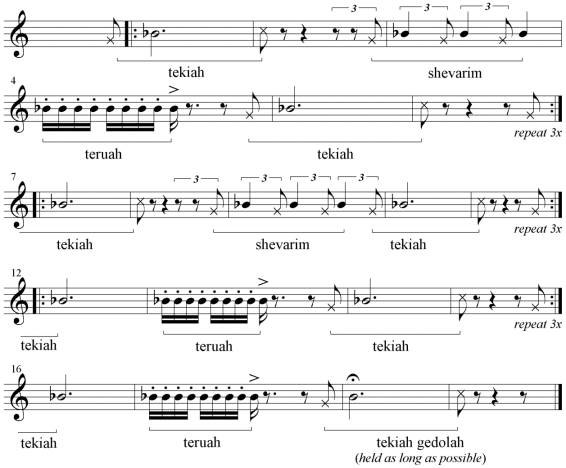
Thereafter, two Priests stood atop of a marble stand near the altar signaling trumpet blasts: tekiah, tekiah and teruah. A long note followed a series of short notes; then another long note.

On Rosh Hashanah and other full holidays (Day of Atonement, Ingathering of the harvest [Succot], Passover and the Feat of Weeks – Pentecost) a single Priest perfected two sacrifices in honor of the full holiday, Note that festivals such as Hanukah and Purim), are not considered full holidays requiring an extra sacrifice. On Rosh Hashanah, something special occurred during the special sacrifice. Arguably two Shofar Sounders played the long notes and one Trumpet player played the short note. Accordingly, Rosh HaShanah is called Yom Teruah (the day of the blast).

Otherwise, the Trumpets had “top billing.” Rosh Hashanah27a, supports this claim: “Said Raba or it may have been R. Joshua B. Levi: What is the scriptural warrant fore this? – Because  it is written, “With trumpets and the sound of the Shofar shout ye before the King in the Temple, we require trumpets and the sound of the Shofar; elsewhere not.” See also Sidney B. Hoenig, Origins of the Rosh Hashanah Liturgy, The Jewish Quarterly Review, New Series, Vol. 57, The Seventy-Fifth Anniversary Volume of the Jewish Quarterly Review (1967), pp. 312-331.   Published by: University of Pennsylvania Press.


Indeed, on Yom Kippur, the Shofar was sounded to announce the Jubilee Year (every 50-years, Jews were granted freedom, forgiveness and debts and reclamation of sold lands. Shofar first indicated in Yovel (Jubilee Year -  Lev. 25:8-13). Indeed, in Rosh Hashanah 33b, the sages ask why the Shofar sounded in Jubilee year.  Further support is found in Rosh Hashanah 29a, where the Talmud talks of trumpets for sacrifices but Shofar in the Jubilee Year does not apply to priests who are exempt from the obligations of the jubilee. Perhaps, we have the first mention of Shofar Sounding by non-Priests. Perhaps the first distancing away from the Sacrificial Cult.

Otherwise, for all other special days, the Shofar is sounded shorter and two special silver Trumpets announced the sacrifice.

When the trumpets sound the signal, all the people who are within the sacrifice prostate themselves, stretching out flat, face down and on the ground.

Indeed, the idea that rabbinic prayer modeled itself of that of the
Temple is supported by:

·       Jeffrey H. Tigay. On Some Aspects of Prayer in the Bible, AJS Review, Vol. 1, (1976), pp. 363-379, Published by: Cambridge University Press on behalf of the Association for Jewish Studies

·       Holman Bible Dictionary: http://www.studylight.org/

·       Arthur L. Finkle, , Easy Guide to Shofar Sounding, Torah Aura, Los Angeles, CA, 2002.